
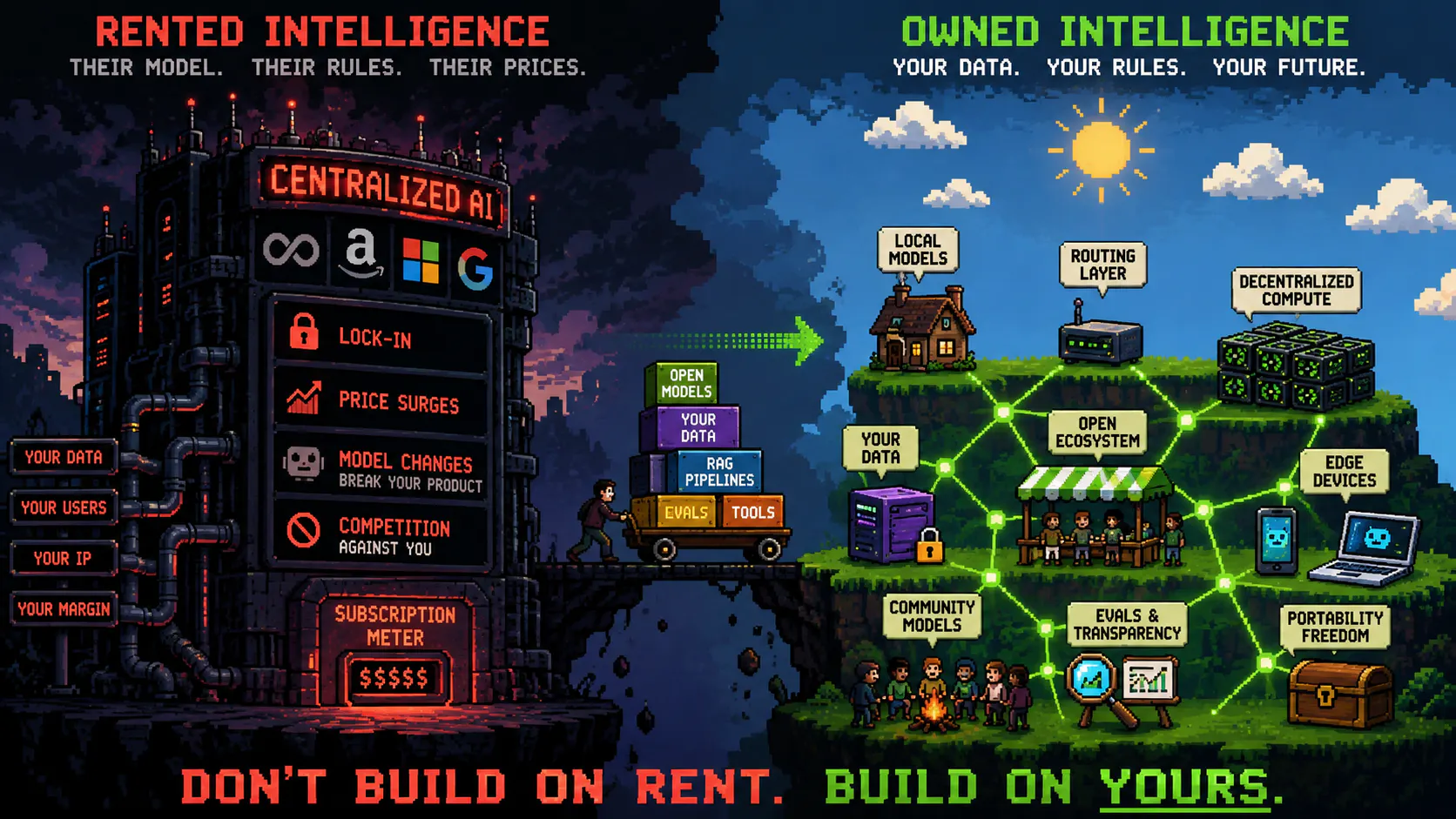
You just spent six months integrating a frontier model into your core product. You fine-tuned a LoRA, optimized your RAG pipeline, and achieved parity with your competitors. Then, your model provider shifts their pricing, updates their model’s "personality" in a way that breaks your edge cases, or introduces a competing feature that effectively shadows your entire business model. You didn’t build a moat; you built a high-end rental property on land you don’t own.
Centralized AI is beginning to look less like a technological revolution and more like a high-stakes coupon business masquerading as innovation. We are witnessing a massive subsidy of inference costs, burning venture capital to make magic feel cheap while the foundational layers—compute, data, talent, and distribution—coalesce into a handful of corporate monopolies.
The Mirage of Centralized Superiority
The narrative suggests that only trillion-dollar companies can conjure "intelligence." In reality, the foundational model companies are effectively subsidizing your prompts. They are burning cash to capture market share, while the underlying economics of compute and talent remain heavy, unforgiving burdens. The next wave of AI startups is being asked to compete with entities that simultaneously own the model, the cloud infrastructure, the app surface, the enterprise relationship, and the default setting.
This is a structural market failure. Building a performant model is difficult, but achieving distribution is the true bottleneck. Doing both while a competitor can underprice you simply because they raised more capital than some nations spend on education is not market efficiency—it is a special kind of industry stagnation. Centralized AI concentrates power exactly where the internet was supposed to dissolve it, turning intelligence into a proprietary utility rented back to you at promotional pricing until the code expires.
Invention vs. Ownership
The contrarian truth is that AI centralization is not a technical necessity; it is an economic capture strategy. We speak of foundational model companies as if they are monolithic alien entities, but inside their walls, the real breakthroughs still come from tiny teams, engineers with whiteboards, and small, nimble clusters of talent. The invention layer looks exactly like a startup.
The ownership layer, however, is a different story. The best researchers do not gravitate toward centralized companies because their architecture is inherently superior. They go there because that is where the largest compute budgets and most significant career insurance policies reside.
The market is currently auctioning off the very people capable of driving the next leap in architecture to whichever firm can afford the most H100s and the longest runway of irrational subsidy. Centralized AI doesn't win because it is smarter; it wins because it can outspend the possibility of competition before a rival can secure a distribution channel.
Building the Anti-Monopoly Stack
The pressure valve here is open-source and open-weight models. DeepSeek is the cleanest proof point—and a necessary cautionary tale. According to their technical reports, they trained DeepSeek-V3 on 14.8T tokens using 2.664M H800 GPU hours for pretraining, with an additional 0.1M hours for later stages. As Stanford’s AI Lab (led by Andrew Ng) noted in their transparency reviews, DeepSeek disclosed training compute but not the total all-in operational costs. Even so, the output is undeniable.
Current open-weight leaderboards—including the March 2026 data from Onyx—list over 20 major models, such as Llama 4 Maverick, Gemma 3, and Qwen 3.5, scoring in the high 80s or 90s on MMLU. We have passed the point where GPT-3.5 is a moat; it is now a historical mile marker.
To break the rent-seeking cycle, we need to attack centralization at every layer:
- Model Routing: Implement protocols that dynamically route queries to the cheapest-good-enough model rather than locking into a single API provider.
- Edge Inference: Shift private, high-frequency tasks to local environments to reduce latency and data exposure.
- Open Evals: Rely on shared, public benchmarks to prevent marketing departments from laundering metrics into destiny.
- Domain-Specific RAG: Use RAG systems to make your internal corpus—your unique institutional knowledge—the primary differentiator, effectively commoditizing the model layer.
- Decentralized Compute: Utilize decentralized GPU markets to bypass cloud provider lock-in for training and fine-tuning runs.
The solution is not "one open model to rule them all." That just reconstructs the cathedral. The solution is a bazaar: many models, many hosts, and enough portability that the user retains the leverage.
Don't Let Your Model Become Your Accountant
Your company’s support tickets, source code, and unique institutional knowledge are not just "data"—they are the raw materials of your future leverage. If you pour that data into a centralized platform, that platform learns your business, mediates your workflows, and eventually sells a version of your own intelligence back to you with a monthly usage cap.
You must treat AI as infrastructure, not as an oracle. Individuals should keep copies of their prompts and outputs, while companies must separate their knowledge base from their model vendor. Build your products so the AI layer can be swapped like a database. If your provider becomes your memory, your interface, and your distribution channel all at once, you have ceased to be a founder and have instead become a tenant.
What I'm Still Figuring Out
I have deep reservations about the viability of decentralized compute at the scale required for frontier-level pretraining. While we can easily run inference or perform LoRA fine-tuning across distributed nodes, coordinating the checkpoint sharding and synchronization required for a 10T+ parameter model without massive, centralized interconnects feels like a pipe dream right now.
I also worry about the "versioning hell" of a truly decentralized ecosystem. If we fragment into a thousand different models, do we lose the ability to maintain robust safety guardrails or consistent RLHF alignments? Can a bazaar of models ever match the polished, integrated UX of a walled-garden product? I suspect we will always trade some efficiency for independence, but I am still working to quantify exactly how much that friction costs in a production environment.
The 2030 Vision: Intelligence as Plumbing
By 2030, the vision of decentralized AI should look less like a glowing chatbot in the sky and more like electricity: invisible, cheap, and boring. Your laptop will run a private model that understands your specific writing style. Your company will house its own models that parse customer data without ever leaking it to a third party. Your phone will intelligently route tiny tasks to tiny models, heavy reasoning to frontier models, and sensitive tasks to local models, without you ever needing to care which vendor did the work.
The winners of this shift will not be the companies with the largest temples of GPUs. They will be the builders who turn intelligence into everyday leverage, creating products where the model is just a modular, replaceable hammer.
The Reality of the Climb
We have to be honest: this is not an easy transition. Moving away from a "plug-and-play" API to an open-weight stack involves significant engineering overhead. You will need to manage your own inference endpoints, handle model drift, and potentially invest more in your MLOps pipeline than you would by simply paying a monthly subscription to a foundation model company. This path requires a higher baseline of technical literacy and a willingness to own your own stack’s reliability.
Practical Next Steps
For CTOs and Engineering Leaders
Stop treating "AI Strategy" as a model-selection exercise. Instead, build an evaluation framework that benchmarks your internal tasks against at least three different model architectures (local vs. API-based). Conduct a POC on migrating a non-critical internal service to a self-hosted open-weight model to test your team’s ability to manage inference latency and cost-per-token.
For Developers and ML Engineers
Stop relying on proprietary web UIs. Start building with frameworks like LiteLLM to handle model-agnostic API calls. If you are fine-tuning, look into Axolotl for your training pipelines and experiment with vLLM for high-throughput serving. The goal is to ensure your codebase never assumes the underlying model is permanent.
For Curious Learners
Engage with communities that prioritize model transparency. Follow the Hugging Face spaces for leaderboard updates, but dig into the papers themselves. Don't just watch the numbers—run the weights locally using Ollama or LM Studio. Getting hands-on with local inference is the fastest way to understand why ownership of your own model weights matters.
The goal is a future where you control your intelligence, not a tenant in someone else’s data center. The monopoly UI is a choice, not a technical inevitability.
This post is part of the DecentralizeAI Hackathon — made possible by Nosana (decentralized GPU compute), Arweave (permanent decentralized storage), and HackerNoon. Especially interested in hearing from people who've tried open-source in production.