
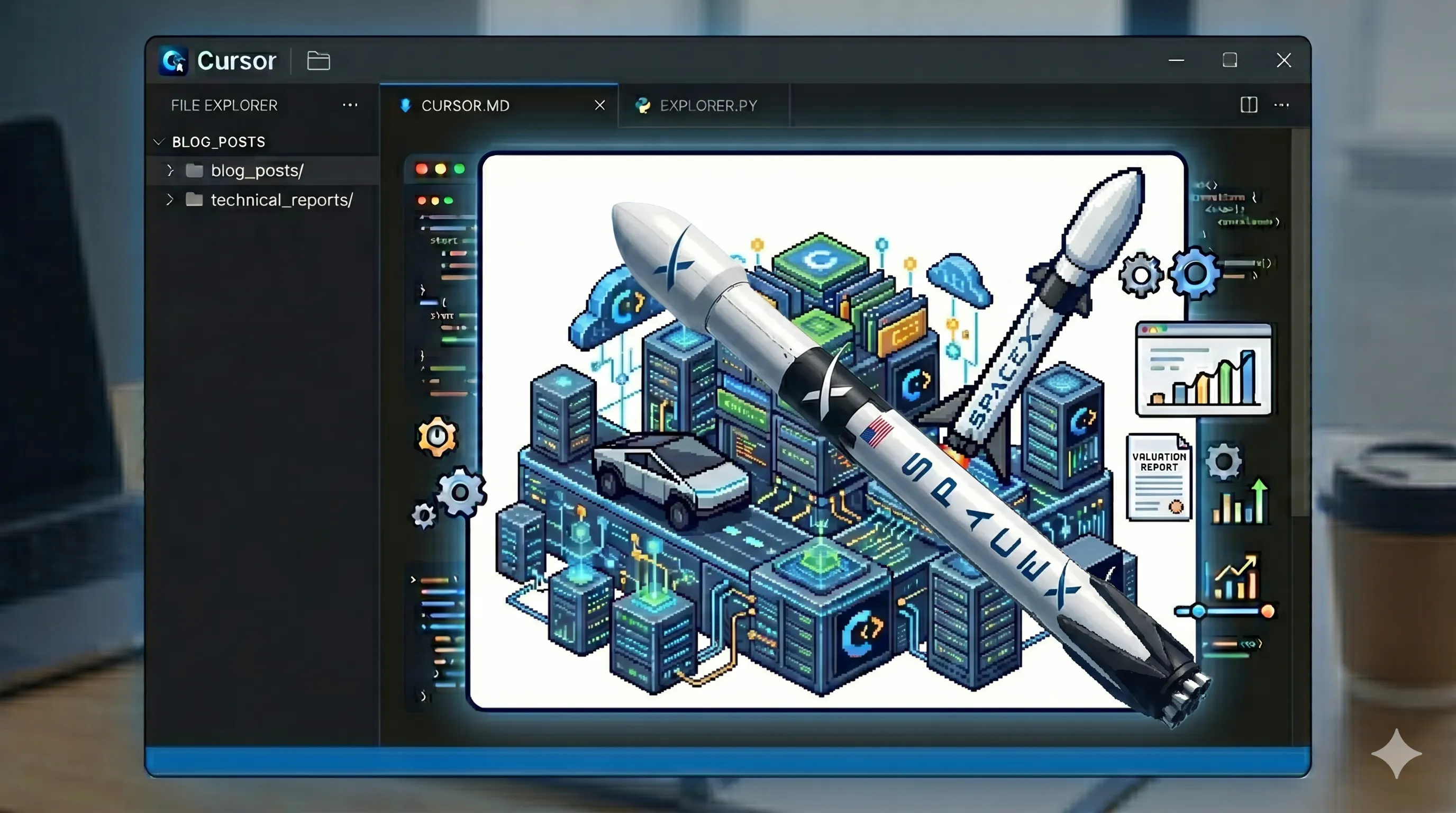
The intersection of aerospace engineering, frontier artificial intelligence, and developer tooling reached a historic and highly controversial nexus in April 2026. SpaceX, fresh off its massive $1.25 trillion all-stock merger with Elon Musk’s artificial intelligence venture xAI in February 2026, announced a paradigm-shifting arrangement with Anysphere, the parent company of the ubiquitous AI-powered code editor, Cursor.1
At stake is a $60 billion acquisition option, a $10 billion partnership fallback fee, and the underlying infrastructural control of how software will be written, tested, and deployed in the coming decade.1 For the software engineering community, this is not merely a financial headline; it is a structural earthquake.
To understand the reality of this transaction, one must entirely divorce the technological substance from the astronomical valuations and the inescapable gravitational pull of corporate public relations apparatuses. The narrative presented to the market by both SpaceX and Cursor highlights a utopian synthesis of unparalleled supercomputing and best-in-class developer distribution. The reality, however, is a deeply complex tapestry of financial engineering designed to protect a multi-trillion-dollar Initial Public Offering (IPO), a tacit admission of internal capability failures at xAI, and a looming, highly volatile crisis over model neutrality and geopolitical data governance.
This exhaustive technical report cuts through the PR phrasing to identify what is materially new in this arrangement. It explores the profound implications for software engineers and the broader Software-as-a-Service (SaaS) ecosystem, highlights the glaring contradictions regarding enterprise security, and maps the strategic power shifts defining the 2026 technology landscape.
What Was Announced: The Mechanics of the $60 Billion Option
On Tuesday, April 21, 2026, SpaceX released a public statement via the X platform detailing a deep structural partnership with Cursor. The announcement explicitly defined a dual-path financial and technological agreement that firmly places the independent developer tool within the orbit of the Musk technology conglomerate.1
The Official Statements
The communication strategy was highly coordinated, relying on direct posts from corporate accounts and executive leadership rather than traditional press releases. The primary announcement from the official SpaceX account stated verbatim: "SpaceXAI and @cursor_ai are now working closely together to create the world's best coding and knowledge work AI. The combination of Cursor's leading product and distribution to expert software engineers with SpaceX's million H100 equivalent Colossus training supercomputer will allow us to build the world's most useful models. Cursor has also given SpaceX the right to acquire Cursor later this year for $60 billion or pay $10 billion for our work together." 5
Simultaneously, Michael Truell, the 25-year-old CEO and co-founder of Cursor, confirmed the arrangement. Mirroring the optimism of the parent company, Truell posted verbatim on X: "Excited to partner with the SpaceX team to scale up Composer. A meaningful step on our path to build the best place to code with AI." 5
The Dual-Path Financial Architecture
The arrangement between the two entities is not a standard, immediate acquisition. Instead, it is a highly engineered financial structure utilizing a call option paired with an immediate infrastructure integration. The architecture provides SpaceX with two distinct, legally binding pathways to execute before the end of 2026:
- The Acquisition Option: SpaceX has secured the exclusive right to acquire Cursor outright for a staggering $60 billion valuation.1 If executed, this would easily stand as the largest acquisition of a private artificial intelligence startup in the history of the technology sector, drastically dwarfing previous industry benchmarks.
- The Partnership Fallback (The Breakup Fee): Should SpaceX decline to exercise the $60 billion acquisition option by the end of the year, it is contractually obligated to pay Anysphere $10 billion.1 This fee is officially framed as payment for the joint technological work completed during the intervening months, but functions practically as an unprecedented termination or "breakup" fee for a few months of strategic alignment.3
The Asset Exchange: Compute for Distribution
The technological core of the announcement centers on a symbiotic, and somewhat desperate, exchange of specific assets: raw compute in exchange for developer distribution.
Cursor brings an immense, highly engaged audience of expert software engineers. Founded in 2022 by four MIT students—Michael Truell, Aman Sanger, Sualeh Asif, and Arvid Lunnemark—the platform released its first product in March 2023 and experienced hyper-growth.9 By February 2026, Cursor had crossed $2 billion in Annualized Recurring Revenue (ARR), making it the fastest-growing Business-to-Business (B2B) company in history, effectively scaling from zero to $2 billion in roughly 36 months.9 Currently, more than half of the Fortune 500 companies utilize its product.7
In return for access to this developer ecosystem, SpaceX provides Cursor with unfettered access to "Colossus." Located in Memphis, Tennessee, the Colossus supercomputing cluster is widely reported to contain the equivalent computational power of one million Nvidia H100 Graphics Processing Units (GPUs).2
Asset Exchanged | SpaceX / xAI Contribution | Cursor / Anysphere Contribution | Strategic Objective of the Exchange |
Financial Capital | $60B Call Option or $10B Partnership Fee | Exclusive acquisition rights and model routing integration | Lock in the premier developer asset without immediately disrupting SpaceX's 2026 IPO timeline. |
Technological Hardware | "Colossus" Supercomputer Cluster (1M H100 equivalent GPUs) | "Composer" AI assistant interface and proprietary coding telemetry | Resolve Cursor's severe compute bottleneck; solve xAI's complete lack of developer distribution and telemetry data. |
Human Capital | Direct reporting lines to Elon Musk | Pre-deal engineering transfers (Andrew Milich, Jason Ginsberg) | Inject proven, world-class AI coding engineering talent into the struggling xAI ecosystem. |
What’s Actually New Here: Cutting Through the PR Language
Corporate announcements in the artificial intelligence sector are routinely draped in visionary, world-building rhetoric. Stripping away the terminology of "the world's best coding AI" reveals a deeply pragmatic, highly defensive, and somewhat cynical set of maneuvers by both organizations. What is actually new in this deal is not a sudden breakthrough in artificial coding intelligence, but rather a masterclass in IPO protection, a strategic admission of internal failure, and a ruthless demonstration of how raw compute is now weaponized to subjugate the application layer.
The Admission of xAI's Internal Engineering Failures
Beneath the veneer of a synergistic partnership lies a tacit, multi-billion-dollar admission: xAI failed entirely to build a competitive coding model internally.
Despite having access to unprecedented compute resources, xAI's internal tools lagged severely behind Anthropic's Claude Code and OpenAI's Codex systems.3 The industry reality is that raw compute alone, no matter how vast, does not yield a superior specialized model. Training state-of-the-art coding agents requires massive, continuous datasets of proprietary user interactions, keystroke traces, debugging workflows, and reinforcement learning derived from how expert human engineers solve complex edge cases. Without an application layer to harvest this specific telemetry, xAI was essentially operating a supercomputer in a vacuum.
The technology community rapidly deduced the reality of this arrangement. Analyst Richard Wu summarized the actual mechanics flawlessly on X: "The structure of the deal is pretty interesting here. I think what's happening is: 1. xAI is having trouble training a SOTA coding model (hence cofounder departures), bunch of idle GPUs 2. Cursor doesn't have capital to blow on a $5B training run to compete with Codex/Claude".5
This transaction is a $60 billion shortcut to acquire the proprietary data flows that xAI could not generate organically. The departure of two senior engineering leads from Cursor—Andrew Milich and Jason Ginsberg—who left the startup in March 2026 to join xAI directly and report to Musk, foreshadowed this reality.1 The deal confirms that the Musk conglomerate is abandoning organic development of coding Integrated Development Environments (IDEs) in favor of buying the market leader outright.6
Financial Engineering as IPO Protection
The most critical revelation is the structure of the deal itself. A $60 billion acquisition is virtually unprecedented, particularly for a company founded a mere four years prior. Yet, the choice to structure this as a call option rather than an immediate buyout is entirely driven by SpaceX’s macroeconomic calendar.
SpaceX is actively preparing for a massive public market debut, targeting a public listing as early as June 2026.10 Internal financial models and market speculators project an initial valuation ranging from $1.5 trillion to $2 trillion, which would easily cement it as the largest IPO in global financial history, surpassing Saudi Aramco's $29 billion record from 2019.10
Absorbing a $60 billion asset outright in April 2026 would require monumental updates to financial disclosures, extensive regulatory audits, and highly complex Securities and Exchange Commission (SEC) filings. Such a bureaucratic burden would inevitably delay the June IPO target.10 Teddy Schleifer of the New York Times aptly noted the anomaly on X, stating, "Don't often see a $50 billion acquisition just before an IPO".5
By structuring the deal as an option with a $10 billion partnership fee, SpaceX places a massive, unmatchable deposit to take Cursor off the open market. This effectively blocks rivals like OpenAI, Anthropic, or Google from acquiring the startup, while allowing SpaceX to keep its own balance sheet relatively clean for the impending public offering. To the financial markets, this signals that a $10 billion breakup fee is viewed as an acceptable, strategic price to preserve the sacred IPO timeline while securing exclusive access to the most vital application layer in the software development space.10
The FTX Irony and the Liquidity of AI
No analysis of the Cursor valuation is complete without addressing the sheer absurdity of early-stage venture capital mechanics highlighted by this deal. Prior to its current $60 billion option, Cursor raised a $2.3 billion Series D in November 2025, pushing its valuation to $29.3 billion.3
However, the deepest irony lies in the historical capitalization table. During its earliest days, the cryptocurrency exchange FTX purchased a 5% stake in Cursor for a mere $200,000.16 Following the collapse of FTX, liquidators sold off that 5% stake to recover funds for defrauded creditors, receiving only the initial $200,000.16 At the $60 billion option valuation established by SpaceX, that 5% stake would theoretically be worth $3 billion today. The transaction highlights the violent volatility and immense wealth creation occurring in the generative AI sector, where early bets can multiply by tens of thousands of percentage points within a 36-month window.
Why This Matters: Focus on Developers, Builders, and the Ecosystem
For the developers, software engineers, and enterprise architects who actually rely on these tools daily, the SpaceX-Cursor transaction is not merely a financial headline—it is an infrastructural event horizon. Cursor has become the default interface for modern software creation, and its absorption by an aerospace and AI conglomerate fundamentally alters the rules of engagement for the entire builder ecosystem.
The Impending Death of IDE Neutrality
The single greatest value proposition of Cursor, and the primary catalyst for its rapid adoption across the Fortune 500, was its strict model neutrality. Built as an intelligent fork of Microsoft’s open-source Visual Studio Code, Cursor functioned as an agnostic routing layer. A developer could seamlessly switch between OpenAI’s GPT-4o, Anthropic’s Claude 3.5 Sonnet, Google’s Gemini, or specialized local models depending on which architecture performed best for a specific programming language or logic task.
The SpaceX deal severely threatens to end this era of neutrality. Market analysts, including Deepika Giri of IDC, project that under SpaceX ownership, the incentive structure will inevitably shift to prioritize xAI's Grok and Cursor's proprietary Composer models trained on the Colossus cluster.7 It makes zero financial sense for SpaceX to pay a $60 billion premium for a developer tool only to watch millions of software engineers route their API calls and subscription dollars to Anthropic or OpenAI.
If Cursor degrades the experience of using third-party models, artificially throttles competitor APIs, or actively sunsets subprocessor agreements with rival AI labs, developers will be forced into a captive walled garden. This lock-in effect strips builders of their agility.
Furthermore, rival foundation model providers will likely take defensive action. Fearing that proprietary user traces and engineering prompts are being siphoned through Cursor to train xAI's competing models, companies like OpenAI or Anthropic may preemptively cut Cursor’s API access entirely. Anthropic previously executed a similar restriction against the AI IDE Windsurf to protect its intellectual property; a similar, highly disruptive defensive move against a SpaceX-owned Cursor is highly probable, leaving developers caught in the crossfire of corporate warfare.7
The "Fortnite Effect", Seat Compression, and the SaaS Meltdown
The software development ecosystem is currently undergoing a macroeconomic crisis often referred to in venture capital circles as the "Fortnite Effect" or "seat compression".17 Traditional Software-as-a-Service (SaaS) companies operate on a per-seat licensing model; revenue grows as a company hires more employees and buys more licenses.
However, AI coding agents like Cursor's Composer have drastically increased the productivity of individual engineers. Complex refactoring, boilerplate generation, and multi-file debugging tasks that once required hundreds of manual steps by junior engineers can now be executed autonomously by the AI.18 Because one senior engineer armed with Cursor can now output the equivalent code of three or four junior developers, technology companies are aggressively halting the expansion of their engineering headcount.
This leads directly to a reduction in the total number of software licenses sold across the entire tech stack—fewer seats for GitHub, Atlassian Jira, Slack, Datadog, and Figma. Prominent industry analyst and SaaStr founder Jason Lemkin has actively observed this systemic shift, bluntly declaring on the 20VC podcast that "much of traditional SaaS is dying" because the underlying metric of growth—human headcount—is shrinking in the face of agentic AI.19
During a highly publicized debate on the 20VC podcast with Harry Stebbings and Scale Venture Partners' Rory O'Driscoll, Lemkin pointed out that many SaaS companies are now in an "unfinanceable zone".17 They have respectable revenue but lack the massive growth trajectory required to command venture returns, entirely because AI tools like Cursor are compressing the Total Addressable Market (TAM) of human seats. Lemkin noted that Net Retention Rate (NRR) is plummeting globally because "customers renew at 90% of seats each cycle," hiding a massive structural problem in the industry.17
For developers, the SpaceX acquisition of Cursor accelerates this transition. By backing Cursor with the infinite compute of Colossus, SpaceX is heavily betting that the future of software engineering requires drastically fewer humans typing syntax. The industry is moving toward "vibe coding"—a paradigm where developers act as high-level architectural orchestrators, writing natural language prompts and managing AI agents, while the machine handles the raw syntax implementation.20
Compute as the Ultimate Moat
For the broader ecosystem of independent builders, the deal sends a chilling and definitive message regarding market competition. Cursor was the ultimate startup success story. It was founded by four students, achieved $2 billion in ARR in three years, and possessed a deeply loyal user base.9 Yet, even with $2 billion in revenue, $3.3 billion in venture funding, and backing from heavyweights like Andreessen Horowitz and Nvidia, it could not survive as a fully independent entity in the face of the compute bottleneck.9
In a blog post published the day of the announcement, the Cursor team explicitly admitted that their efforts to advance their agentic coding models had been fundamentally "bottlenecked by compute".3 Training frontier models like Composer 2 requires capital expenditures that traditional venture capital simply cannot sustain. A $5 billion training run is increasingly becoming the baseline cost of entry to compete with Microsoft and Google.5
This transaction formally establishes raw compute as the ultimate currency, and the ultimate monopoly, in the 2026 tech ecosystem. Startups do not need venture dollars; they need guaranteed, priority access to zoned, powered, and networked silicon.
Venture capitalist Chamath Palihapitiya perfectly encapsulated this power shift regarding the deal: "The game theory in AI has shifted. Having a leading foundational model is important but increasingly it is the zoning approved, powered land that is the gating bottleneck. Add turnkey access to silicon and it's checkmate. If you have that, you have immense negotiating leverage." 12
The developer ecosystem is rapidly consolidating into a system of infrastructural neo-feudalism. Independent software vendors must eventually pledge loyalty to the megacorporations that control the physical data centers. Builders constructing tools today must operate under the assumption that they will inevitably be forced to align with an infrastructure provider—be it Microsoft Azure, Amazon Web Services, Google Cloud, or now, SpaceX/xAI.
What’s Questionable or Unclear: The Reality Check
Despite the celebratory tone of the social media posts and the staggering financial figures, several core aspects of the Cursor-SpaceX alignment are highly questionable. A critical examination of the underlying technology, enterprise contracts, and the parent company's broader, often science-fiction ambitions reveals severe vulnerabilities that could derail the utility of the tool for serious developers.
The Kimi 2.5 Geopolitical Liability
The most glaring, immediate, and potentially catastrophic issue facing the integration is the origin of Cursor's highly touted Composer 2 model. While Cursor heavily marketed Composer 2 as a proprietary breakthrough achieved through advanced pretraining and reinforcement learning, industry analysts and technology reviewers recently uncovered a highly controversial foundation: Composer 2 is heavily fine-tuned on Kimi 2.5, a Chinese Large Language Model developed by the Beijing-based startup Moonshot AI.7
Cursor’s Vice President of Developer Education, Lee Robinson, was forced to publicly admit that a quarter of the computational power relies on this original Chinese model, though he argued that the heavy reinforcement learning applied on top makes Composer 2's performance "very different" from Kimi 2.5.18 On proprietary benchmarks like CursorBench, Composer 2 achieved a score of 61.3 (compared to 44.2 for Composer 1.5), providing frontier-level quality at a fraction of the cost, largely due to this base architecture.18
However, in the realm of enterprise software, cybersecurity, and government contracting, the distinction between a base model and a fine-tune is largely irrelevant.
Gartner principal analyst Nitish Tyagi explicitly warned the market regarding this discovery, stating: “Composer is fine-tuned on the Chinese base model Kimi 2.5, making it unsuitable for organizations with restrictive governance policies.” 7
SpaceX is fundamentally a United States defense contractor. It handles highly classified payloads for the Space Force, NASA, and the Department of Defense. The proposition that a US defense contractor is acquiring an AI tool reliant on a geopolitical adversary's base model is a massive compliance liability.
For developers working in heavily regulated industries—finance, healthcare, defense, and public infrastructure—using an IDE with data flows connected to Chinese foundation models violates strict data sovereignty and software supply chain laws. The SpaceX announcement completely ignored this constraint. It remains entirely unclear whether the Colossus cluster will be utilized to hastily scrub Kimi 2.5 from the architecture, or if enterprise users will be forced to abandon Composer 2 entirely to maintain legal compliance.
Enterprise Data Contracts vs. The Need for Training Data
Cursor’s meteoric rise in the enterprise sector was largely predicated on strict, legally binding security guarantees. The company’s enterprise tier boasts a strict "Zero Data Retention" policy, guaranteeing that neither Cursor nor its routed LLM providers will use proprietary corporate codebases to train future AI models.7 Furthermore, Cursor offers a system-wide "Privacy Mode" for organizations, ensuring complete data isolation operating on SOC 2 Type II compliant AWS infrastructure.7
With the introduction of xAI into the equation, these promises are in severe jeopardy. As previously noted, the primary motivation for xAI to absorb Cursor is to acquire the telemetry, code traces, and user data necessary to train a competitive coding model.5
As one observer on X bluntly stated: "without coding data you are cooked".5
This creates an irreconcilable paradox. If SpaceX honors Cursor's enterprise privacy commitments, xAI is legally denied the data it desperately needs to close the gap with OpenAI and Anthropic. If SpaceX quietly alters the terms of service to allow data scraping for the Colossus cluster, it will violently violate the trust of the Fortune 500 companies—including Nvidia, Salesforce, Stripe, and PwC—currently deploying the software, risking massive corporate churn.7 Analysts have already advised Chief Information Officers (CIOs) to demand strict "change-of-control clauses" with 90 to 180-day exit notices before the acquisition option window closes, bracing for the inevitable erosion of data privacy.7
The Orbital Data Center Delusion
It is impossible to analyze a SpaceX-xAI announcement without scrutinizing the persistent, science-fiction narratives deployed by Elon Musk to inflate valuations. In the context of the xAI merger and the Cursor integration, Musk has repeatedly claimed that terrestrial data centers are hitting permanent power constraints, and that the only logical path forward is to build "space-based AI".3
SpaceX officially claims it will launch a constellation of one million satellites operating as orbital data centers, capturing solar power directly in space to provide 1 Terawatt (TW) of AI compute capacity.7 This initiative is described in official corporate updates as a first step toward humanity becoming a "Kardashev II-level civilization" capable of harnessing the full power of the sun, and scaling toward making a "sentient sun" to expand the "light of consciousness".7
To software developers trying to debug a Python script on a Tuesday afternoon, this narrative is not just unhelpful; it is a profound distraction from terrestrial hardware realities. Deploying data centers in low Earth orbit ignores the basic physics of thermal management in a vacuum, the severe latency limitations of routing complex, multi-turn AI workloads through atmospheric interference, and the sheer impossibility of launching one million tons of microprocessors into space economically, even with the Starship platform.
Connecting a highly pragmatic, highly effective B2B tool like Cursor to the hype cycle of "orbital data centers" suggests that a significant portion of the $60 billion valuation is an attempt to inject AI euphoria into the impending SpaceX IPO narrative, rather than a grounded, executable strategy for improving developer productivity.
Valuation Sanity
Finally, the sheer scale of the financial figures warrants a reality check. Cursor is a highly successful tool, but it is ultimately a wrapper and a fine-tune built on top of VS Code and third-party LLMs.
Prominent short-seller James Chanos questioned the fundamental logic of the parent company's structure, tweeting: "Um, isn't that why @SpaceX 'bought' xAI for $250B...?!".5 If SpaceX already purchased xAI for $250 billion, ostensibly to dominate the AI landscape, paying an additional $60 billion for an IDE highlights severe capital inefficiency.
Furthermore, developer Benjamin De Kraker asked the pertinent question: "Is Cursor really worth 4% of SpaceX's entire (projected) IPO value? What exactly is valuable inside Cursor here that justifies $60 Billion? Or is it an acquihire, using Cursor staff to build back the gutted xAI?".5 The numbers suggest that SpaceX is paying a massive premium not for the intrinsic value of the software, but for the narrative momentum it provides heading into the public markets.
Questionable Aspect | Stated PR Narrative | Underlying Technical Reality |
Model Architecture | Proprietary breakthrough via advanced reinforcement learning. | Heavily reliant on Kimi 2.5, a Chinese base model, creating severe DoD compliance risks. |
Data Privacy | Zero data retention; strict SOC 2 Type II compliance. | xAI desperately needs proprietary code traces to train models; privacy terms are likely to erode. |
Future Infrastructure | "Orbital data centers" powering AI from space. | Defies physics of thermal management and latency; functions primarily as IPO hype generation. |
Valuation Logic | $60B reflects the value of the "world's best coding AI". | $60B is a premium paid to block competitors and acquire engineering talent xAI couldn't hire. |
The Bigger Picture: Connecting to Broader AI Trends
The SpaceX and Cursor arrangement is a perfect microcosm of the macro-level tectonic shifts occurring across the technology industry in 2026. This transaction sits at the volatile intersection of venture capital economics, the rapid commoditization of software, and the physical limits of planetary energy infrastructure.
The 2026 Mega-IPO Convergence
The timing of this transaction is intrinsically linked to the broader financial markets. After years of muted activity following the 2021 tech bubble, 2026 is shaping up to be the year of the "Mega-IPO." Massive private entities are finally seeking public liquidity after years of hoarding venture capital.
SpaceX alone is targeting a public debut that could raise upwards of $30 billion, aiming for valuations near $1.5 trillion to $2 trillion.10 In this climate, narrative is just as valuable as underlying revenue. By attaching the fastest-growing AI startup in history to its prospectus via a $60 billion call option, SpaceX forces public market investors to evaluate it not just as a spaceflight and satellite internet company, but as a dominant, vertically integrated AI hyper-scaler.6 It positions SpaceX alongside Microsoft, Amazon, and Google in the enterprise software narrative. The actual technological integration of Cursor may be secondary to the sheer financial gravity the association provides ahead of the public listing.
The Commoditization of the Base Model
The Kimi 2.5 controversy highlights a profound shift in the AI value chain. The fact that Cursor achieved frontier-level performance by heavily modifying an open-access Chinese model demonstrates that base models are rapidly commoditizing.7
The competitive advantage in the AI sector is definitively shifting away from building a foundational Large Language Model from scratch. The true value now lies in fine-tuning, reinforcement learning, and highly specific application interfaces. Cursor proved that a superior user experience and targeted agentic workflows can easily outcompete generalized models like standard GPT-4. However, in absorbing Cursor, SpaceX is attempting to reverse-engineer this success, utilizing Cursor's application-layer data to retroactively build the foundational model xAI failed to create.
The Future of the Builder Ecosystem
For builders and developers, the immediate future requires a highly defensive posture. While the infusion of the Colossus supercomputer into Cursor’s backend may yield short-term gains in the intelligence of the Composer models, the long-term strategic costs are incredibly steep. The loss of model neutrality, the precarious state of enterprise data privacy, and the undeniable geopolitical risks of the underlying Kimi 2.5 architecture present severe hurdles for widespread corporate reliance.
Furthermore, the structure of the deal—a $60 billion call option masking a $10 billion partnership fee to protect an IPO timeline—reveals that the priorities governing Cursor's future are inherently financial, rather than product-driven. Developers are no longer the primary customer; they are the training data generation engine for xAI's broader ambitions.
As traditional SaaS models contract and agentic AI continues to replace human syntax generation, developers must adapt to a reality where the tools they rely upon are heavily weaponized assets in a trillion-dollar infrastructure war. The SpaceX-Cursor deal is not just an acquisition; it is the definitive blueprint for the industrialization of artificial intelligence, where the builders of software are merely temporary tenants on the landlord's compute.
Works cited!
- Musk Wants Cursor: $60B Acquisition, $10B Partnership, and Tech's ..., accessed April 22, 2026, https://yage.ai/share/xai-cursor-acquihire-en-20260421.html
- SpaceX could buy Cursor for $60B; the pair partner on AI model training, accessed April 22, 2026, https://techfundingnews.com/spacex-cursor-60b-acquisition-option-10b-collaboration-xai/
- SpaceX Agrees to Potential $60B Deal to Acquire Cursor - AI Business, accessed April 22, 2026, https://aibusiness.com/generative-ai/spacex-agrees-potential-60b-deal-acquire-cursor
- Cursor AI Deal April 22: SpaceX Eyes $60B Buyout Option, accessed April 22, 2026, https://meyka.com/blog/cursor-ai-deal-april-22-spacex-eyes-60b-buyout-option-2204/
- Techmeme, accessed April 22, 2026, https://www.techmeme.com/260421/p48
- SpaceX Moves Toward $60B Cursor Acquisition to Boost AI Ahead ..., accessed April 22, 2026, https://www.indianweb2.com/2026/04/spacex-moves-toward-60b-cursor.html
- SpaceX secures option to acquire AI coding startup Cursor for $60B | InfoWorld, accessed April 22, 2026, https://www.infoworld.com/article/4161997/spacex-secures-option-to-acquire-ai-coding-startup-cursor-for-60b.html
- SpaceX Strikes $60 Billion Deal With AI Coding Start-Up Cursor - VKTR, accessed April 22, 2026, https://www.vktr.com/ai-news/spacex-strikes-60-billion-deal-with-ai-coding-start-up-cursor/
- SpaceX strikes $60B Cursor agreement, united by a common adversary, accessed April 22, 2026, https://www.binance.com/en/square/post/315217308112961
- SpaceX Cursor Deal: $60B Buy Option, $10B Partnership Alternative - The Silicon Review, accessed April 22, 2026, https://thesiliconreview.com/2026/04/spacex-cursor-deal-60-billion-acquisition-option
- SpaceX secures option to buy AI coding startup Cursor for $60B, accessed April 22, 2026, https://thenextweb.com/news/spacex-cursor-60-billion-acquisition
- Techmeme, accessed April 22, 2026, https://techmeme.com/index.html
- Why is Elon Musk Spending US$60bn on an AI Startup?, accessed April 22, 2026, https://businesschief.com/news/why-is-elon-musk-spending-us-60bn-on-an-ai-startup
- 2026 IPO Outlook: SpaceX, OpenAI & 10 Mega Companies | VERTU, accessed April 22, 2026, https://vertu.com/lifestyle/the-3-6-trillion-ipo-wave-10-mega-companies-set-to-transform-markets-in-2026
- SpaceX Locks In $60 Billion Option to Acquire AI Coding Giant Cursor - Inbenta, accessed April 22, 2026, https://www.inbenta.com/ai-this-week/spacex-locks-in-60-billion-option-to-acquire-ai-coding-giant-cursor
- SpaceX Eyes $60B Cursor Deal, Signaling New AI Coding Era - Coinpedia, accessed April 22, 2026, https://coinpedia.org/news/spacex-eyes-60b-cursor-deal-signaling-new-ai-coding-era/
- The 20VC Pricing Playbook: What 30 Weeks of Stebbings, Lemkin & O'Driscoll Reveal About the Real Price of Tech - VC Game by Mighty Nine, accessed April 22, 2026, https://thevcinsider.substack.com/p/the-20vc-pricing-playbook-what-30
- Cursor's advanced AI coding model has Chinese origins - Techzine Global, accessed April 22, 2026, https://www.techzine.eu/news/devops/139815/cursors-advanced-ai-coding-model-has-chinese-origins/
- "Jason (Analyst)" Search Results — Stock Quotes & Related News, accessed April 22, 2026, https://finance.biggo.com/s/Jason%20(Analyst)?hot_keyword=1
- The AI Fix - RedCircle, accessed April 22, 2026, https://redcircle.com/shows/the-ai-fix5064
- Cursor and Kimi 2.5: When Omission Erodes Trust in AI - Foro3D, accessed April 22, 2026, https://foro3d.com/en/2026/march/cursor-and-kimi-25-when-omission-erodes-trust-in-ai.html